The Need for Safety Stocks Can Be Reduced by an Operations Strategy Which:
This article outlines the many types of inventory, provides real-world examples and covers inventory management. Understanding the best inventory practices and analysis techniques will help you get the all-time return on investment (ROI) for your business.
What Is Inventory?
Inventory is the accounting of items, component parts and raw materials that a company either uses in production or sells. As a business leader, you practice inventory management in order to ensure that y'all accept plenty stock on hand and to identify when there's a shortage.
The verb "inventory" refers to the act of counting or list items. As an bookkeeping term, inventory is a current asset and refers to all stock in the various production stages. Past keeping stock, both retailers and manufacturers tin continue to sell or build items. Inventory is a major asset on the balance canvass for almost companies, however, too much inventory can go a practical liability.
Video: What Is Inventory?
Primal Takeaways
- Inventory, which describes any appurtenances that are set for purchase, directly affects an system's financial wellness and prosperity.
- While there are many types of inventory, the four major ones are raw materials and components, work in progress, finished goods and maintenance, repair and operating supplies.
- While there are many ways to count and value your inventory, the importance lies in accurately tracking, analyzing and managing it. Insights gained from inventory evaluations are necessary for success as they help companies make smarter and more cost-efficient business concern decisions.
Inventory Explained
An organization's inventory, which is ofttimes described as the step between manufacturing and order fulfillment, is primal to all of its business operations as it oftentimes serves as a principal source of acquirement generation. Regardless of the fact that inventory tin be described and classified in numerous means, it's ultimately its direction that direct affects an organization's society fulfillment capabilities.
For example, in keeping track of raw materials, rubber stock, finished goods or fifty-fifty packing materials, businesses are collecting crucial information that influences their future purchasing and fulfillment operations. Understanding purchasing trends and the rates at which items sell determines how often companies need to restock inventory and which items are prioritized for re-purchase. Having this information on hand can improve customer relations, cash catamenia and profitability while also decreasing the amount of money lost to wasted inventory, stockouts and re-stocking delays.
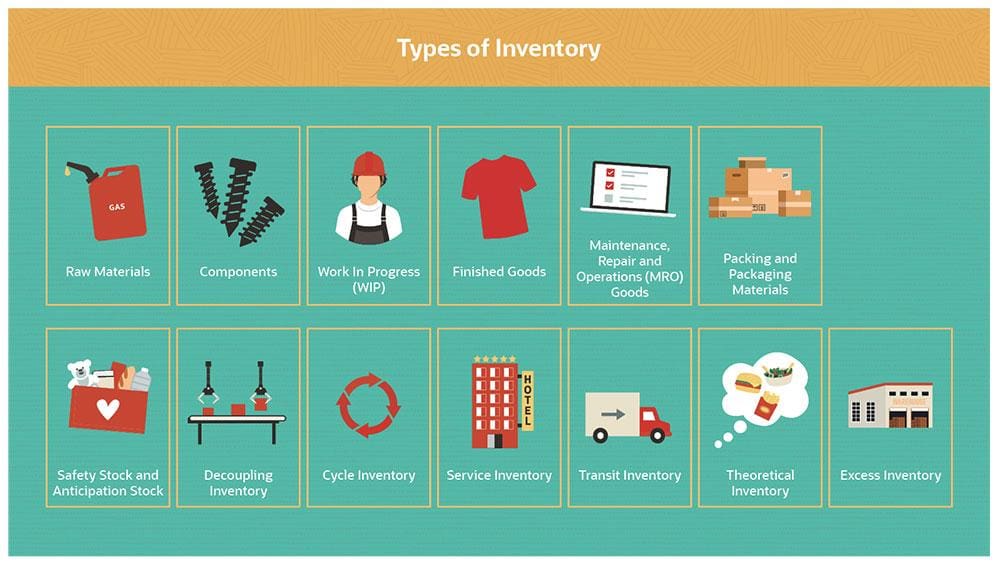
13 Types of Inventory
-
Raw Materials:
Raw materials are the materials a company uses to create and finish products. When the product is completed, the raw materials are typically unrecognizable from their original form, such every bit oil used to create shampoo. -
Components:
Components are like to raw materials in that they are the materials a company uses to create and finish products, except that they remain recognizable when the product is completed, such as a screw. -
Work In Progress (WIP):
WIP inventory refers to items in production and includes raw materials or components, labor, overhead and even packing materials. -
Finished Goods:
Finished goods are items that are set to sell. -
Maintenance, Repair and Operations (MRO) Goods:
MRO is inventory — often in the form of supplies — that supports making a product or the maintenance of a business concern. -
Packing and Packaging Materials:
There are three types of packing materials. Primary packing protects the product and makes it usable. Secondary packing is the packaging of the finished good and can include labels or SKU information. Tertiary packing is bulk packaging for send. -
Safety Stock and Anticipation Stock:
Rubber stock is the actress inventory a company buys and stores to cover unexpected events. Safety stock has conveying costs, but it supports client satisfaction. Similarly, anticipation stock comprises of raw materials or finished items that a business concern purchases based on sales and production trends. If a raw material's price is rise or elevation sales fourth dimension is budgeted, a business concern may purchase safety stock. -
Decoupling Inventory:
Decoupling inventory is the term used for extra items or WIP kept at each production line station to prevent work stoppages. Whereas all companies may take safety stock, decoupling inventory is useful if parts of the line work at different speeds and simply applies to companies that manufacture appurtenances. -
Cycle Inventory:
Companies gild cycle inventory in lots to go the right amount of stock for the everyman storage toll. Learn more about bicycle inventory formulas in the "Essential Guide to Inventory Planning." -
Service Inventory:
Service inventory is a management accounting concept that refers to how much service a business concern tin can provide in a given period. A hotel with 10 rooms, for case, has a service inventory of 70 one-night stays in a given week. -
Transit Inventory:
Besides known as pipeline inventory, transit inventory is stock that'south moving between the manufacturer, warehouses and distribution centers. Transit inventory may take weeks to move between facilities. -
Theoretical Inventory:
Too called book inventory, theoretical inventory is the least amount of stock a visitor needs to consummate a procedure without waiting. Theoretical inventory is used by and large in production and the nutrient manufacture. It's measured using the bodily versus theoretical formula. -
Excess Inventory:
Also known equally obsolete inventory, excess inventory is unsold or unused appurtenances or raw materials that a company doesn't expect to utilize or sell, only must still pay to shop.
Inventory Examples
Real-world examples can make inventory models easier to empathise. The post-obit examples demonstrate how the dissimilar types of inventory work in retail and manufacturing businesses.
-
Raw Materials/Components:
A company that makes T-shirts has components that include material, thread, dyes and print designs. -
Finished Appurtenances:
A jewelry manufacturer makes amuse necklaces. Staff attaches a necklace to a preprinted bill of fare and slips it into cellophane envelopes to create a finished adept ready for auction. The cost of goods sold (COGS) of the finished good includes both its packaging and the labor exerted to make the item. -
Work In Progress:
A cell phone consists of a case, a printed circuit board, and components. The process of assembling the pieces at a dedicated workstation is WIP. -
MRO Goods:
Maintenance, repair and operating supplies for a condominium customs include copy paper, folders, printer toner, gloves, glass cleaner and brooms for sweeping upwardly the grounds. -
Packing Materials:
At a seed company, the primary packing material is the sealed bag that contains, for example, flax seeds. Placing the flax seed bags into a box for transportation and storage is the secondary packing. Tertiary packing is the shrink wrap required to ship pallets of production cases. -
Safety Stock:
A veterinarian in an isolated customs stocks up on disinfectant and dog and cat treats in lodge to meet customer demand in instance the highway floods during spring thaw and delays commitment trucks. -
Anticipated/Smoothing Inventory:
An event planner buys discounted spools of ribbon and floral tablecloths in anticipation of the June nuptials season. -
Decoupled Inventory:
In a bakery, the decorators keep a store of sugar roses with which to beautify hymeneals cakes–so even when the ornament team'due south supply of frosting mix is late, the decorators can keep working. Because the flowers are part of the block'southward design, if the baker ran out of them, they couldn't deliver a finished cake.one -
Cycle Inventory:
As a restaurant uses its last 500 paper napkins, the new refill order arrives. The napkins fit hands in the dedicated storage space. -
Service Inventory:
A café is open for 12 hours per day, with ten tables at which diners spend an average of one hr eating a repast. Its service inventory, therefore, is 120 meals per day. -
Theoretical Inventory Cost:
A restaurant aims to spend thirty% of its upkeep on food but discovers the bodily spend is 34%. The "theoretical inventory" is the 4% of food that was lost or wasted. -
Book Inventory:
The theoretical inventory of stock in the inventory tape or organization, which may differ from the actual inventory when you perform a count. -
Transit Inventory:
An fine art store orders and pays for 40 tins of a popular pencil set. The tins are en route from the supplier and, therefore, in transit. -
Excess Inventory:
A shampoo company produces l,000 special shampoo bottles that are branded for the summertime Olympics, but information technology merely sells 45,000 and the Olympics are over — no ane wants to buy them, then they're forced to discount or discard them.
What Is Manufacturing Inventory?
In manufacturing, inventory consists of in-stock items, raw materials and the components used to make appurtenances. Manufacturers closely rails inventory levels to ensure there isn't a shortage that could stop work.
Accounting divides manufacturing stock into raw materials, WIP and finished goods because each type of inventory bears a different price. Raw materials typically cost less per unit than do finished items.
What Does Inventory Mean in the Service Industry?
Every company has stock that supports its regular business. For service companies, this inventory is intangible. A police firm'south inventory, for example, includes its files, while newspaper on which to print legal documents is the firm's MRO.
The Importance of Inventory Control
Inventory control helps companies buy the right amount of inventory at the correct time. Also known as stock control, this procedure helps optimize inventory levels, reduces storage costs and prevents stockouts.
Find out more in the "Essential Guide to Inventory Control."
Inventory Best Practices
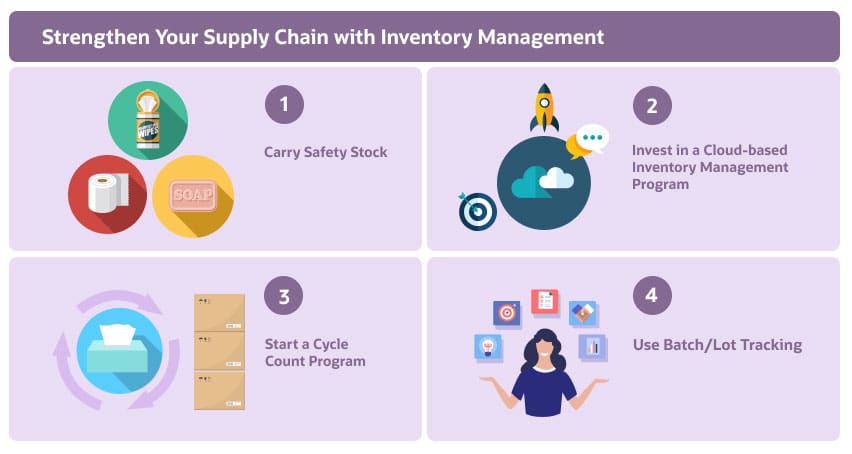
The business concern saying "if you can't measure it, yous can't manage it" applies to inventory direction and all-time practices. While the beginning best practice is keeping track of your inventory, others include:
-
Carry Safety Stock:
Too known as buffer stock, these products aid keep companies from running out of materials or high-need items. Once companies deplete their calculated supply, rubber stock serves as a backup should the level of demand increase unexpectedly. -
Invest in a Deject-based Inventory Management Program:
Cloud-based inventory management systems let companies know in existent-time where every product and SKU are located globally. This data helps an organization exist more than responsive, up-to-appointment, and flexible. -
Start a Cycle Count Program:
Wheel counting benefits extend well past the warehouse by keeping stock reconciled and customers happy while also saving businesses time and money. -
Apply Batch/Lot Tracking:
Record data associated with each batch or lot of a production. While some businesses log precise details, such as expiration dates that provide data nearly their products' sellable dates, companies that do non have perishable goods use batch/lot tracking to understand their products' landing costs or shelf lives.
What Is Inventory Process?
An inventory process tracks inventory every bit companies receive, shop, manage, and withdraw or consume it equally work in progress. Essentially, the inventory process is the lifecycle of appurtenances and raw materials.
Come across a diagram of the inventory process flow and learn more past reading "The Essential Guide to Inventory Planning."
What Is Inventory Count?
An inventory count is the physical act of counting and checking the condition of items in storage or a warehouse. An inventory count also checks the status of items. For accounting purposes, inventory counts aid assess avails and debts.
Inventory counts assist you sympathise which stock is moving well and inventory managers often use this data to forecast stock needs and manage budgets. To learn more virtually inventory counting, read the articles on "Taking Concrete Inventory" and "Bike Counting 101."
Methods of Recording of Inventory
The two methods of recording inventory are periodic and perpetual. In periodic inventory, you count stock at specific times and add the totals to the full general ledger. In the perpetual method, yous record changes in stock as they occur.
Although any blazon of business can use periodic inventory, small organizations oft utilise it, specially when there are no plans to scale the business concern. The periodic method requires no special software or equipment. Organizations that use perpetual inventory recording methods and crave real-time counting frequently use scanners and point-of-sale (POS). To learn more than about each method, read "The Periodic System: Is It the Correct Choice?" and "The Definitive Guide to Perpetual Inventory."
What Is Inventory Turnover?
Inventory turnover is the number of times a company sells or uses an item in a specific timeframe, which can reveal whether a company has too much inventory on paw. To determine inventory turnover, use the post-obit equations:
Boilerplate inventory = (Beginning Inventory + Ending Inventory) / 2
Inventory turnover = Sales + Average Inventory
To learn more than almost inventory turnover, read "Inventory Turnover Primer: Calculations, Rates and Analyses."
What Is Inventory Analysis?
Inventory assay is the written report of how production need changes over time and it helps businesses stock the correct amount of goods and project how much customers will want in the future.
A well-known method for performing inventory analysis is ABC assay. To perform an ABC analysis, group goods into three categories:
-
A inventory: A inventory includes the best-selling products that require the least space and cost to store. Many experts say this represents near 20% of your inventory.
-
B inventory: B items move at a similar rate to A items but cost more to store. Generally, this represents most forty% of your inventory.
-
C inventory: The remainder of your stock costs the most to store and returns the lowest profits. C inventory represents the other xl% of your inventory.
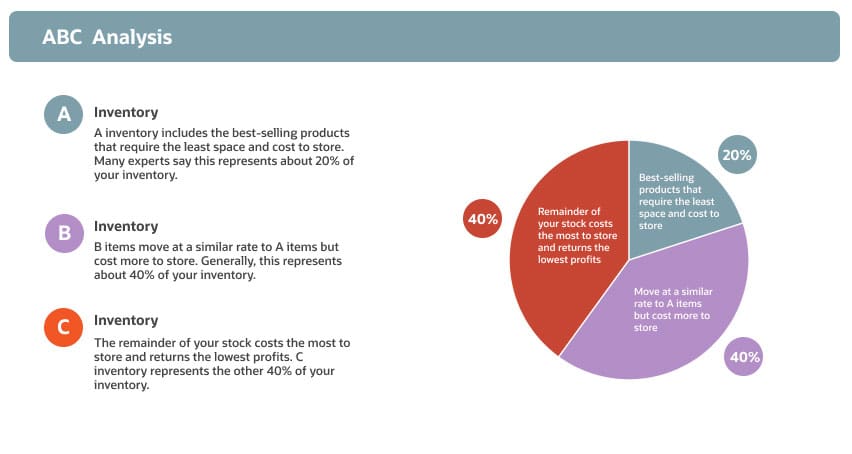
ABC analysis leverages the Pareto, or fourscore/20, principle and should reveal the 20% of your inventory that garners fourscore% of your profits. A visitor will want to focus on these items to increment sales and cyberspace profit margins.
Inventory assay may influence the choice of inventory control methods, whether just-in-fourth dimension or just-in-instance. For more than data on inventory analysis and command, see the "Essential Guide to Inventory Control."
Benefits of Inventory Analysis
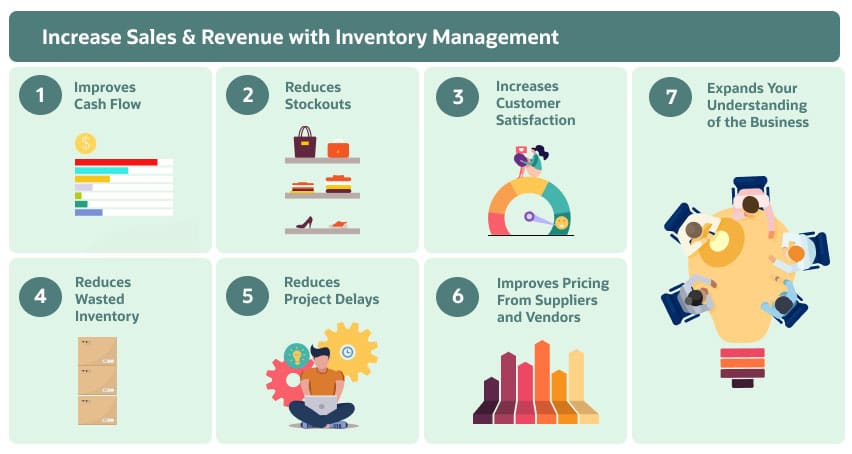
Inventory analysis raises profits by lowering costs and supporting turnover. It besides:
-
Improves Cash Flow: Inventory analysis helps you place and reorder items yous sell frequently, so you don't spend money on inventory that moves slowly.
-
Reduces Stockouts: When you lot empathise which inventory customers desire well-nigh, you can better anticipate need and prevent stockouts.
-
Increases Customer Satisfaction: Analyzing inventory offers insight into what and how customers purchase goods.
-
Reduces Wasted Inventory: Agreement what, when and how much people buy minimizes the need to store obsolete products, as well as when products expire then you can have a strategy behind using them.
-
Reduces Project Delays: Learning about supplier pb times helps you understand when to reorder and how to avert late shipments.
-
Improves Pricing From Suppliers and Vendors: Inventory assay can lead you to social club high volumes of products regularly rather than small volumes on a less reliable schedule. This regularity can put yous in a stronger position to negotiate discounts with suppliers.
-
Expands Your Understanding of the Business: Reviewing inventory provides insights into your stock, customers and business.
What Is Demand Forecasting?
Demand forecasting is the practice of predicting customer demand by looking at past buying trends, such as promotions and seasonality. Accurately predicting demand provides a amend agreement of how much inventory you'll demand and reduces the need to store surplus stock.
Learn more about demand forecasting in our "Essential Guide to Inventory Planning."
Benefits of Inventory Direction and Accurate Inventory
A proficient inventory management strategy and authentic inventory counts tin can aid salvage companies money because they'll but provide items that customers buy and therefore, simplify their operations. Read about more benefits in the commodity "Top Inventory Management Benefits."
Bookkeeping for Inventory
Accounting for inventory is the system that counts and records changes in the value of stock such as raw materials, WIP and finished appurtenances, which are all considered assets. Financial accounting for inventory provides an accurate valuation of these stock assets.
Inventory bookkeeping determines the value for stock items and the right item count. These figures constitute the costs of goods sold and the ending inventory value, which gene into the company's overall value.
What Is Average Inventory Toll?
The average cost of inventory is a method for calculating the per-unit of measurement cost of goods sold. To summate the average cost, get the sum of the cost of all stock for auction, and divide it by the number of items sold.
This method is also chosen weighted average cost. Learn more well-nigh boilerplate inventory toll in the commodity "The Key to Using Inventory Cost Accounting Methods in Your Business concern."
NetSuite Software for Managing All Your Inventory Needs
Properly managing inventory can make or break a business. Having insight into your stock at any given moment is critical to success. Decision makers know they need the correct tools in place to be able to manage their inventory effectively. NetSuite offers a suite of native tools for tracking inventory in multiple locations, determining reorder points and managing safety stock and bike counts. Find the right residual between demand and supply across your unabridged organization with the need planning and distribution requirements planning features.
NetSuite provides cloud inventory management solutions that are the perfect fit for companies within the startup to modest businesses to Fortune 100 range. Larn more than near how you can use NetSuite to help programme and manage inventory, reduce treatment costs and increase cash flow.
Inventory FAQs
What Are the Four Different Inventory Types?
There are four chief types of inventory: raw materials/components, WIP, finished appurtenances and MRO. Withal, some people recognize simply 3 types of inventory, leaving out MRO. Understanding the different types of inventory is essential for making sound financial and product planning choices.
Source: https://www.netsuite.com/portal/resource/articles/inventory-management/inventory.shtml

Post a Comment for "The Need for Safety Stocks Can Be Reduced by an Operations Strategy Which:"